Author: China Chem Supplies
Publication date: 27 September 2026
Introduction
China is one of the world’s major manufacturing centers for chemicals, pharmaceutical raw materials, industrial materials, laboratory reagents, specialty chemicals, and chemical intermediates.
For U.S. companies, universities, laboratories, manufacturers, distributors, and other professional buyers, sourcing chemicals internationally can provide access to a broad manufacturing base. However, finding a supplier is only the beginning.
A successful chemical sourcing program requires much more than comparing prices.
Buyers need to evaluate product identity, specifications, analytical documentation, manufacturing capability, quality systems, packaging, regulatory requirements, transportation, import documentation, and supplier reliability before placing an international order.
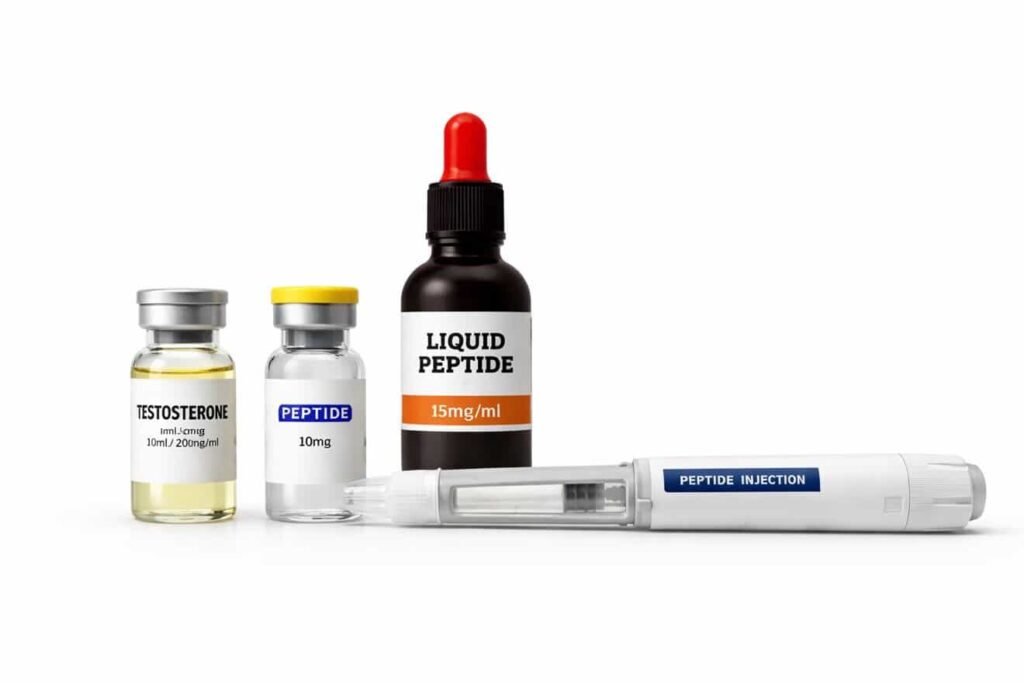
The same principle applies to purchasing research chemicals online. A professional laboratory should distinguish legitimate research-use materials from websites marketing unapproved medicines, controlled substances, or products intended for human consumption.
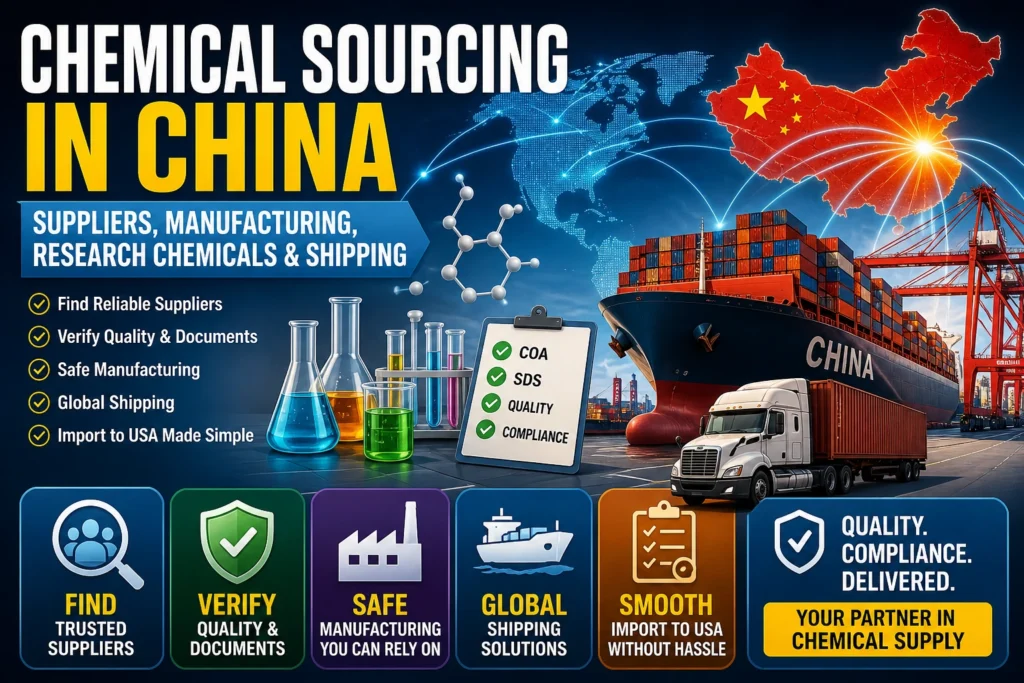
This guide explains what professional buyers should know about chemical sourcing in China, chemical manufacturing, research-chemical procurement, supplier verification, quality documentation, and international chemical shipping.
What Is Chemical Sourcing?
Chemical sourcing is the process of identifying, evaluating, qualifying, and purchasing chemical products from manufacturers, distributors, or specialized suppliers.
A sourcing process can involve:
- Product identification
- CAS number verification
- Purity requirements
- Grade selection
- Technical specifications
- Certificate of Analysis (COA)
- Safety Data Sheet (SDS)
- Manufacturing capability
- Packaging requirements
- Minimum order quantity
- Production lead time
- Export documentation
- Transportation requirements
- Import regulations
- Quality inspection
For industrial buyers, sourcing is therefore a technical and supply-chain function, rather than simply finding the lowest quoted price.
Why Do Companies Source Chemicals From China?
China has a large and diverse chemical manufacturing ecosystem covering commodity chemicals, specialty chemicals, intermediates, laboratory materials, agricultural chemicals, construction chemicals, water-treatment products, and other industrial inputs.
A buyer may consider Chinese suppliers because of:
Manufacturing capacity
Large manufacturing clusters can support substantial production volumes across many chemical categories.
Product diversity
Suppliers may offer everything from commodity industrial chemicals to specialized intermediates and laboratory materials.
Custom specifications
Some manufacturers can support particular grades, concentrations, particle sizes, packaging formats, or other technical requirements.
Export experience
Established exporters may already have experience preparing commercial documentation and coordinating international logistics.
Supply-chain integration
A sourcing company can potentially consolidate products from multiple qualified manufacturers rather than requiring the buyer to manage every supplier independently.
However, country of origin should never substitute for supplier qualification. The appropriate supplier depends on the chemical, application, regulatory status, required specifications, and destination country.
How Do You Choose a Chemical Supplier in China?
The best supplier-selection process begins with technical and compliance verification rather than price alone.
Before evaluating quotations, establish exactly what you need.
A professional supplier assessment should consider:
1. Product identity
Confirm the:
- Chemical name
- CAS number
- Molecular formula
- Grade
- Concentration
- Physical form
- Intended industrial or laboratory application
A chemical name alone may not adequately identify the required material.
2. Specification
Define the acceptance criteria before requesting quotations.
Depending on the product, specifications may include:
- Assay
- Purity
- Moisture
- Appearance
- Particle size
- pH
- Density
- Residual solvents
- Heavy metals
- Specific impurities
3. Documentation
Request appropriate documentation such as:
Certificate of Analysis (COA)
Provides analytical results for a particular batch.
Safety Data Sheet (SDS)
Provides hazard, handling, storage, transport, and emergency information.
Technical Data Sheet (TDS)
Provides technical characteristics and application information where applicable.
Additional documentation may be required depending on the chemical and destination market.
4. Manufacturing capability
Determine whether you are dealing with:
- Manufacturer
- Authorized distributor
- Trading company
- Sourcing company
- Export intermediary
There is nothing inherently wrong with using a distributor or sourcing company, but buyers should understand the supply-chain structure.
5. Batch traceability
For quality-sensitive applications, the ability to associate analytical documentation with a specific production batch is important.
What Should a Chemical COA Contain?
A Certificate of Analysis should provide meaningful information about the tested material rather than simply stating that a product is “high purity.”
Depending on the chemical, a COA may include:
- Product name
- CAS number
- Batch/lot number
- Manufacturing date
- Test parameters
- Test methods
- Specification limits
- Actual analytical results
- Units
- Pass/fail status
- Testing date
- Authorized laboratory or quality-control information
For regulated or technically sensitive applications, buyers should determine whether supplier testing is sufficient or whether independent third-party testing is appropriate.
Why Is an SDS Important When Buying Chemicals?
An SDS (Safety Data Sheet) is a fundamental safety document for chemical handling.
It can provide information covering:
- Hazard identification
- Composition
- First-aid measures
- Fire-fighting measures
- Accidental-release procedures
- Handling and storage
- Exposure controls
- Personal protection
- Physical and chemical properties
- Stability and reactivity
- Toxicological information
- Ecological information
- Disposal considerations
- Transport information
- Regulatory information
The SDS is particularly important when planning international transportation because chemical hazards can affect packaging, labeling, carrier selection, and transport requirements.
What Does “Research Chemical” Mean?
The term research chemical is used in different ways online, which can create significant confusion.
In legitimate laboratory contexts, it can refer broadly to chemicals supplied for analytical, scientific, research, development, or laboratory applications.
However, some websites use “research chemical” terminology to market products that are actually intended for human consumption or that may be unapproved or controlled substances.
That distinction matters.
For example, FDA enforcement actions have specifically addressed websites marketing products as “research chemicals” or “research use only” where the surrounding marketing indicated intended human use.
Therefore, a professional buyer should evaluate the actual product, intended use, regulatory status, labeling, documentation, and applicable law, rather than relying solely on the words “research chemical.”
Is It Safe to Buy Research Chemicals Online?
Buying laboratory chemicals online can be appropriate when the material is legitimate, properly identified, legally permitted, and obtained through an appropriate professional supply channel.
However, online purchasing creates additional verification challenges.
Before purchasing a laboratory chemical online, verify:
- Supplier identity
- Physical business information
- Chemical identity
- CAS number
- Intended use
- Product specification
- COA
- SDS
- Batch information
- Applicable regulatory restrictions
- Shipping requirements
- Import requirements
- Payment and commercial documentation
For pharmaceuticals and products intended for human use, the situation is different. FDA warns that unsafe online pharmacies may distribute counterfeit, unapproved, misbranded, or improperly stored medicines.
“Research use only” should never be treated as a substitute for regulatory compliance.
How Can You Verify a Chemical Supplier Online?
A supplier’s website is only one source of evidence.
Professional buyers can look for:
Business identity
Check whether the company provides:
- Registered business information
- Physical address
- Corporate contact information
- Manufacturing or warehouse information
- Export experience
Technical information
Look for:
- Product specifications
- COAs
- SDS documents
- TDS documents
- CAS numbers
- Grades
- Packaging information
Manufacturing evidence
Depending on the supplier, useful evidence may include:
- Factory information
- Quality-control procedures
- Certifications
- Production capability
- Inspection records
- Audit documentation
Independent verification
For significant purchases, consider:
- Sample evaluation
- Independent laboratory testing
- Factory audit
- Pre-shipment inspection
- Documentation verification
Why Is a Chemical Sample Important?
A sample can help a buyer evaluate whether the material actually meets the required specification before committing to a larger procurement program.
Depending on the chemical, testing may include:
- Identity confirmation
- Assay/purity
- Moisture
- Impurity profile
- Particle-size analysis
- Physical properties
- Performance testing
A sample does not automatically prove that future production batches will be identical. For recurring procurement, buyers should establish batch specifications and quality-control requirements.
What Is Chemical Manufacturing?
Chemical manufacturing is the industrial process of converting raw materials into defined chemical products through controlled chemical, physical, and purification processes.
Depending on the product, manufacturing can involve:
- Raw-material preparation
- Reaction
- Separation
- Purification
- Concentration
- Drying
- Milling or particle-size control
- Blending
- Quality-control testing
- Packaging
- Batch release
Different chemicals require very different manufacturing technologies.
For this reason, a supplier that produces one chemical successfully is not necessarily qualified to manufacture another.
Manufacturer vs. Chemical Trading Company: What’s the Difference?
A manufacturer produces the chemical.
A trading company or sourcing company may purchase chemicals from manufacturers and coordinate supply to customers.
Neither model automatically guarantees quality.
The important questions are:
- Who actually manufactures the product?
- Can the manufacturer be identified?
- Is the manufacturing site appropriate for the chemical?
- Who performs quality control?
- Who issues the COA?
- Who handles export documentation?
- Who is responsible for resolving quality problems?
For complicated sourcing projects, an experienced chemical sourcing company can provide value by coordinating supplier identification, documentation, sampling, quality verification, and logistics.
How Are Chemicals Shipped From China?
Chemical shipments can move through different transportation modes depending on the material, quantity, destination, urgency, and classification.
Common options include:
Ocean freight
Often appropriate for larger commercial shipments.
Air freight
Can provide faster transportation, but dangerous-goods restrictions and airline requirements can be significant.
Courier services
Potentially suitable for certain small, non-dangerous laboratory materials, subject to carrier and destination restrictions.
Multimodal transportation
A shipment may involve several transportation modes between the manufacturer and final destination.
The correct transportation method depends on the chemical’s classification and the applicable regulations.
How Are Dangerous Chemicals Shipped Internationally?
Dangerous goods require specialized transportation procedures.
For maritime transportation, the International Maritime Dangerous Goods (IMDG) Code establishes mandatory requirements for packaged dangerous goods transported by sea. The IMO states that the 2024 edition, including Amendment 42-24, became mandatory on January 1, 2026.
Depending on the product, dangerous-goods transportation may require consideration of:
- UN number
- Proper Shipping Name
- Hazard class
- Packing group
- Packaging requirements
- Labels and marks
- Transport documentation
- Emergency information
- Carrier acceptance
- Destination-country requirements
This is why a chemical’s SDS and transport classification should be reviewed before shipment arrangements are finalized.
What Documents Are Needed When Importing Chemicals Into the USA?
Documentation depends on the chemical, intended use, shipment type, and applicable U.S. requirements.
Commercial shipments may involve documents such as:
- Commercial invoice
- Packing list
- Bill of lading or air waybill
- SDS
- COA
- Customs documentation
- Import permits or notifications where applicable
- Dangerous-goods documentation where applicable
- Product-specific regulatory documentation
The buyer should determine the requirements applicable to the particular chemical before shipment, rather than assuming that ordinary commercial shipping rules apply.
What Can Cause a Chemical Shipment to Be Delayed?
Several issues can cause delays.
Incorrect documentation
Missing or inconsistent commercial documents can create customs or carrier problems.
Incorrect chemical classification
Dangerous-goods classification must correspond to the actual material.
Packaging problems
Hazardous materials may require specific packaging standards.
Regulatory restrictions
Some chemicals require additional permits, notifications, registrations, or approvals.
Customs examination
Authorities may inspect shipments to verify declarations and compliance.
Carrier restrictions
A carrier may impose requirements beyond ordinary commercial shipping.
Temperature sensitivity
Certain chemicals require controlled storage or transportation conditions.
Why Is Chemical Packaging So Important?
Packaging serves two functions:
Product protection and transport safety.
Packaging may need to protect the material against:
- Moisture
- Oxygen
- Light
- Contamination
- Physical damage
- Temperature variation
For hazardous chemicals, packaging also needs to comply with applicable transport requirements.
The correct packaging depends on the chemical’s physical and hazardous properties.
How Can U.S. Companies Reduce Chemical Sourcing Risks?
A structured procurement process is generally more reliable than choosing suppliers solely based on price.
A practical framework is:
Define → Verify → Sample → Test → Approve → Order → Inspect → Ship → Receive → Review
Define
Establish the exact product specification.
Verify
Evaluate the supplier and manufacturing source.
Sample
Obtain representative material where appropriate.
Test
Confirm that the material meets the agreed specification.
Approve
Qualify the supplier and product.
Order
Document commercial and technical requirements.
Inspect
Perform pre-shipment inspection when appropriate.
Ship
Use appropriate logistics and dangerous-goods procedures.
Receive
Inspect packaging, documentation, and product condition.
Review
Monitor supplier performance for future orders.
What Are the Biggest Mistakes When Sourcing Chemicals From China?
1. Choosing purely on price
The cheapest quotation may not represent the lowest total procurement cost.
2. Not confirming the CAS number
Similar chemical names can refer to different substances or grades.
3. Accepting a generic COA
The documentation should correspond to the actual product and, where applicable, batch.
4. Ignoring the SDS
Safety and transport requirements should be understood before shipment.
5. Not checking regulatory requirements
A chemical that can legally be sold in one country may have restrictions in another.
6. Skipping sample evaluation
For important materials, qualification before large-scale purchasing can reduce risk.
7. Treating “factory direct” as proof of quality
A claim of being a manufacturer should be independently evaluated.
8. Ignoring logistics until after the purchase
Transportation requirements can materially affect cost, timing, and feasibility.
Frequently Asked Questions About Chemical Sourcing in China
What is the best way to source chemicals from China?
The best approach is to define the required specification first, then evaluate qualified suppliers based on product quality, documentation, manufacturing capability, regulatory compliance, logistics, and total cost—not price alone.
How do I verify a Chinese chemical supplier?
Verify the company’s business identity, manufacturing or sourcing role, product documentation, quality systems, production capability, and export experience, and consider independent testing or inspection for important purchases.
What documents should I request from a chemical supplier?
Common documents include a Certificate of Analysis (COA), Safety Data Sheet (SDS), Technical Data Sheet (TDS), commercial invoice, packing information, and applicable regulatory or transport documents.
Can research chemicals be purchased online?
Legitimate laboratory chemicals can be purchased through appropriate professional channels, but buyers must distinguish laboratory materials from unapproved medicines, controlled substances, or products marketed for human use. FDA enforcement demonstrates that calling a product “research use only” does not by itself resolve regulatory issues.
What should I check before buying a research chemical online?
Check the chemical identity, CAS number, specification, intended use, supplier identity, COA, SDS, applicable laws, and shipping requirements before procurement.
How are chemicals shipped from China to the United States?
Depending on the chemical and shipment, transportation may involve ocean freight, air freight, courier services, or multimodal logistics, with dangerous goods subject to additional classification, packaging, documentation, and carrier requirements.
Do all chemicals require dangerous-goods shipping?
No. Dangerous-goods requirements depend on the chemical’s transport classification and applicable regulations. The product’s SDS and transport information should be reviewed before selecting a shipping method.
Why do chemical shipments get held by customs?
Shipments can be delayed because of incomplete documentation, incorrect declarations, regulatory requirements, customs examinations, dangerous-goods issues, or discrepancies between the product and its paperwork.
What is a COA in chemical sourcing?
A Certificate of Analysis is a quality document that reports analytical results for a chemical batch against specified testing parameters and acceptance criteria.
What is an SDS in chemical sourcing?
A Safety Data Sheet provides standardized information about a chemical’s hazards, handling, storage, emergency response, exposure controls, and transportation considerations.
Is China a good source for industrial chemicals?
China has a large and diverse chemical manufacturing base, but suitability depends on the specific product, supplier, quality requirements, regulatory environment, and logistics involved.
Should I choose a chemical manufacturer or sourcing company?
Either can be appropriate depending on the procurement requirement. The important consideration is whether the supply chain can reliably meet the required product specification, documentation, quality, regulatory, and delivery requirements.
Final Checklist for Professional Chemical Buyers
Before approving an international chemical supplier, ask:
Product
- What is the exact chemical identity?
- What is the CAS number?
- What grade is required?
- What purity/specification is required?
Quality
- Is a batch-specific COA available?
- Can the material be independently tested?
- Is the manufacturing source identifiable?
Safety
- Is a current SDS available?
- Is the product hazardous?
- Are special handling or storage conditions required?
Compliance
- Is the chemical permitted for the intended use and destination?
- Are registrations, permits, notifications, or import controls applicable?
Logistics
- What is the transport classification?
- Does the shipment require dangerous-goods handling?
- What packaging is appropriate?
- Which transport mode is suitable?
Supplier
- Who manufactures the product?
- Who performs quality control?
- What happens if the material fails specification?
- Can the supplier provide consistent future batches?
A professional chemical procurement process ultimately comes down to one principle:
Know exactly what you are buying, know who is producing it, verify the quality, understand the regulatory requirements, and plan the shipment before the material leaves the factory.
For U.S. buyers, that approach is particularly important when dealing with pharmaceuticals, unapproved medical products, or materials marketed online as “research chemicals.” FDA continues to warn that products purchased through unsafe online channels can be counterfeit, contaminated, improperly labeled, or otherwise unapproved.